
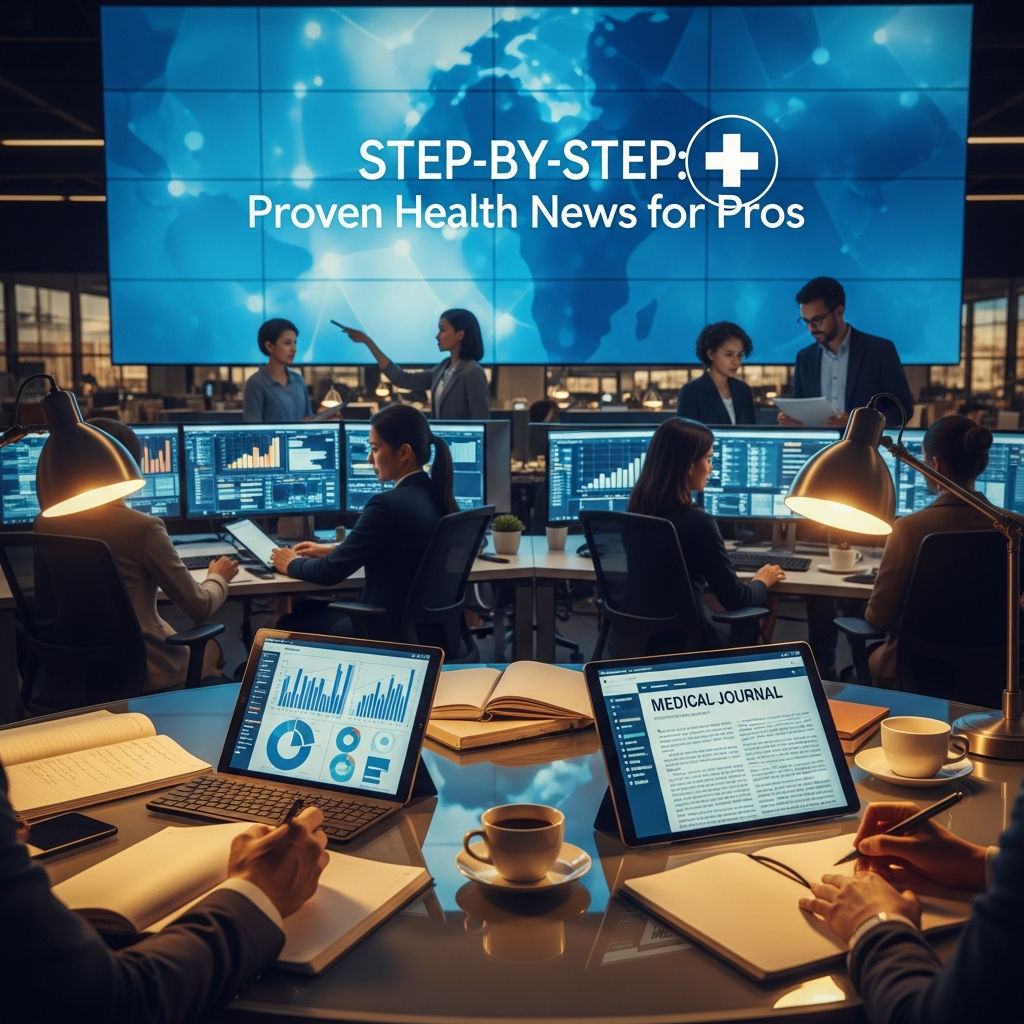
Step-by-Step: Proven Health News for Pros
In the rapidly evolving landscape of medicine, biotechnology, and public health, staying informed isn’t just a professional advantage—it is a clinical necessity. For healthcare providers, researchers, and medical journalists, the challenge is no longer finding information; it is filtering the signal from the noise. Navigating “proven health news” requires a systematic approach to ensure that the data you consume and share is evidence-based, peer-reviewed, and actionable.
This comprehensive guide provides a step-by-step framework for professionals to master the art of consuming health news, evaluating clinical evidence, and maintaining a cutting-edge knowledge base in an era of information overload.
Step 1: Curate a High-Authority Source Matrix
The foundation of professional health news is the source. While mainstream media outlets are useful for general awareness, professionals must prioritize primary and secondary sources that adhere to rigorous editorial and scientific standards. To build a “proven” news feed, focus on these three tiers:
Tier 1: Peer-Reviewed Journals
The “Big Five” journals remain the gold standard for clinical breakthroughs. Ensure your weekly reading includes:
- The New England Journal of Medicine (NEJM): Essential for clinical trials and practice-changing research.
- The Lancet: A leader in global health and oncology news.
- JAMA (Journal of the American Medical Association): Critical for internal medicine and public health policy.
- BMJ (British Medical Journal): Known for its rigorous methodology and advocacy for evidence-based practice.
- Nature Medicine: The go-to source for translational research and biotechnological advancements.
Tier 2: Specialized News Aggregators
For professionals who need distilled updates, platforms like Medscape, Stat News, and Reuters Health offer expert analysis of complex studies. These platforms often provide the “why” behind the data, helping you understand the implications for clinical practice or industry trends.
Tier 3: Regulatory and Governmental Bodies
Never overlook direct updates from the FDA (Food and Drug Administration), EMA (European Medicines Agency), and the CDC (Centers for Disease Control and Prevention). These bodies provide the “proven” final word on drug approvals, safety alerts, and epidemiological shifts.
Step 2: Mastering Database Search and Alerts
Professionals don’t wait for news to find them; they go to where the data lives. Mastering tools like PubMed and Google Scholar is essential for verifying health news claims.
Utilize MeSH Terms: Medical Subject Headings (MeSH) are the NLM’s controlled vocabulary used for indexing articles. Using MeSH terms in PubMed allows you to find specific, proven health news that keyword searches might miss.
Set Up Automated Alerts: Efficiency is key for the busy professional. Use the following tools to automate your news intake:
- PubMed My NCBI Alerts: Set up saved searches for specific topics (e.g., “immunotherapy in NSCLC”) to receive daily or weekly emails of new publications.
- Google Scholar Alerts: Follow specific researchers or seminal papers to see whenever they are cited or publish new work.
- QxMD (Read): An app that organizes your favorite journals into a personalized feed, allowing you to browse “proven health news” on your mobile device between patient consultations.
Step 3: Applying the Hierarchy of Evidence
Not all “proven” health news is created equal. A “pro” must be able to categorize news based on the strength of the underlying evidence. When a new study makes headlines, run it through the Hierarchy of Evidence filter:
1. Systematic Reviews and Meta-Analyses
These sit at the top of the pyramid. If a health news story is based on a Cochrane Review or a meta-analysis of multiple randomized controlled trials (RCTs), the “proven” factor is extremely high.
2. Randomized Controlled Trials (RCTs)
The gold standard for determining causality. Pros look for the sample size (n), the control group, and whether the study was double-blinded. News based on an RCT with a small “n” should be viewed with cautious optimism.
3. Observational Studies
Cohort and case-control studies are excellent for identifying trends and correlations but cannot prove causation. Professionals must be careful not to overstate the results of these studies when communicating with patients or stakeholders.
4. Animal Research and In Vitro Studies
While exciting, news based on mouse models or “test tube” results is “pre-proven” for human application. Professionals should view these as indicators of future directions rather than immediate practice changes.
Step 4: Critical Appraisal of the “Spin”
Even proven health news can be subject to “spin”—the practice of highlighting positive results while downplaying limitations. To read like a pro, look for the following red flags in health reporting:
- Relative vs. Absolute Risk: A headline might scream “New Drug Reduces Heart Attack Risk by 50%!” (Relative Risk). However, if the absolute risk only dropped from 2% to 1%, the clinical impact is much smaller than it appears.
- P-Hacking and Significance: A p-value of <0.05 is the standard for statistical significance, but pros also check for “clinical significance.” Does the result actually improve patient quality of life?
- Conflict of Interest: Always scroll to the bottom of a study to check for funding sources. While industry-funded research is common, it requires a higher level of scrutiny regarding study design and data interpretation.
Step 5: Synthesizing News for Professional Application
The final step in mastering health news is synthesis. Knowledge is only valuable if it can be applied. For the professional, this means translating complex data into actionable insights.
For Clinicians: The Practice Update
When “proven health news” indicates a shift in standard of care, ask: “How does this change my next five patient encounters?” If a new guideline for hypertension is released, your news intake should immediately lead to a review of your current patient roster to identify who may need a medication adjustment.
For Researchers: The Gap Analysis
Pros use news to identify “knowledge gaps.” If a study proves a drug works in a general population, the professional researcher looks for what wasn’t studied—perhaps its efficacy in specific ethnic groups or its long-term side effects.
For Health Communicators: The Literacy Bridge
Health journalists and educators must take “proven health news” and de-jargonize it without losing accuracy. This requires a deep understanding of the “why” so that the “how” can be explained simply to the public.
The Future of Health News: AI and Real-World Evidence
As we move forward, “proven health news” is expanding beyond traditional journals. Real-World Evidence (RWE) gathered from electronic health records and wearable devices is becoming a legitimate pillar of health data. Furthermore, AI-driven tools are now being used to summarize thousands of papers in seconds.
However, the “pro” knows that AI is only as good as the data it is trained on. Human oversight, critical thinking, and the steps outlined above remain the most important tools in a professional’s arsenal.
Conclusion: The Commitment to Lifelong Learning
Mastering proven health news is not a one-time event but a continuous discipline. In the health sectors, “pro” status is maintained by those who respect the rigors of the scientific method while remaining agile enough to pivot when new, high-quality data emerges. By curating elite sources, mastering search tools, and applying a critical eye to every headline, you ensure that your professional expertise remains as current and reliable as the science itself.
Stay curious, stay critical, and let the data lead the way.