


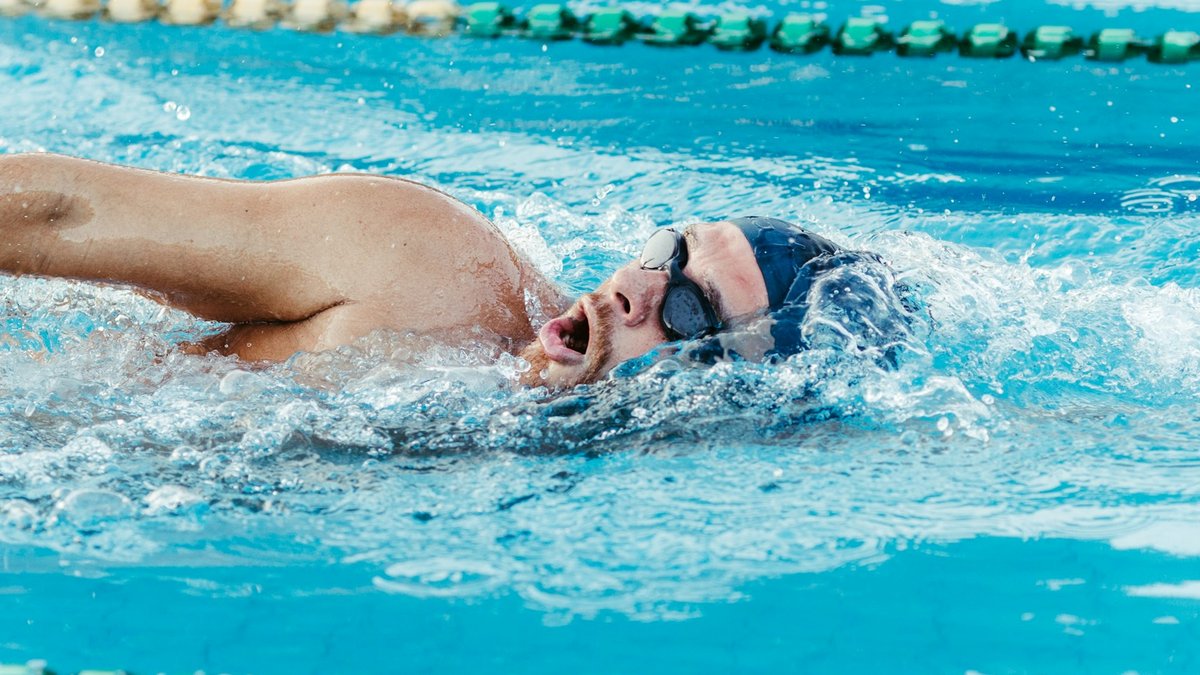
4.2 million adults in England swim at least twice a month, yet many still battle the simplest aspect of front crawl: synchronized breathing. The difficulty does not stem from physical ability or stroke form but from ingrained habits—timing errors, unnecessary tension, and a reliance on head-lifting that disrupts efficiency. Winter, with its quieter pools and lack of competitive urgency, provides an ideal window to correct these patterns before they solidify further.
Breathing in front crawl differs fundamentally from natural respiration. Most adults fall into three recurring errors. First, they hold their breath underwater before panicking to inhale when their head turns. Second, they misinterpret carbon dioxide buildup as a signal for oxygen deprivation, when steady underwater exhalation would actually alleviate that sensation. Third, they lift their entire head to breathe, which drags their body downward and tightens their shoulders, undermining both buoyancy and stroke fluidity.
The correction begins on dry land. Standing in shallow water, swimmers should take a breath, then submerge their face and exhale completely, through nose and mouth, until nearly empty. After lifting to inhale, they repeat the cycle. The emphasis lies on controlled rhythm over speed; ten deliberate repetitions hold more value than one forced attempt.
Read Also: Autumn’s slower pace sparks emotional reckoning in UK
Next comes head-turn technique. Holding the pool wall for support, swimmers submerge their face, blow bubbles, then rotate their head to the side until their mouth clears the water. One ear should remain close to the shoulder, as if resting on a pillow. The breath should emerge from a rolling motion of the torso, not a stiff neck extension.
Once comfortable with static turns, swimmers introduce movement. Floating on their side, they kick while facing upward, then roll to exhale underwater before turning back to inhale. This drills rotation without the pressure of full-stroke swimming. Beginners often start by breathing every two strokes, while others prefer every three. The guiding principle is consistency over rigid rules, what maintains stability takes precedence over what feels theoretically correct.
Mastering the hidden air pocket
Advanced swimmers frequently overlook the “air pocket”, the small trough of air beside their mouth as their head moves forward. Lifting the head fails to capture it; proper rotation does. To fix delayed breathing, swimmers must begin exhaling the instant their face re-enters the water, never waiting until they turn their head.
Read Also: Sleep, Stress and Activity Shape Meal Blood Sugar
For triathletes and open-water swimmers, the off-season offers a rare chance to rebuild breathing mechanics without race-day distractions. Without the pressure of competition, technique can reclaim its priority. Novice swimmers also benefit from weekday sessions, where empty pools and minimal observers create a stress-free environment for experimentation.
Pacing prevents panic breathing
Breathing difficulties often arise from a mismatch between exertion and recovery. Swimmers who force pace, whether in training or competition, compensate with shallow breaths or breath-holding, creating a vicious cycle. The harder they swim, the more they struggle to inhale, which in turn demands even greater effort. The answer is pacing: a sustainable rhythm where each breath arrives without urgency allows the body to relax into the stroke. Most adults can maintain this tempo for at least ten minutes; those who cannot are likely swimming at an unsustainable speed rather than a controlled one.
One persistent error involves exhaling only after turning the head, which wastes time and leaves swimmers gasping. The correct sequence begins exhaling the moment the face re-enters the water, ensuring a full breath is ready by the time the mouth clears the surface. Another common mistake is over-rotating, where the head turns so far that the shoulder lifts out of the water, disrupting the stroke. The target is a gentle roll, just enough to align the mouth with the air pocket without breaking the body’s streamlined position.


